Menú


Contact FORCADELL
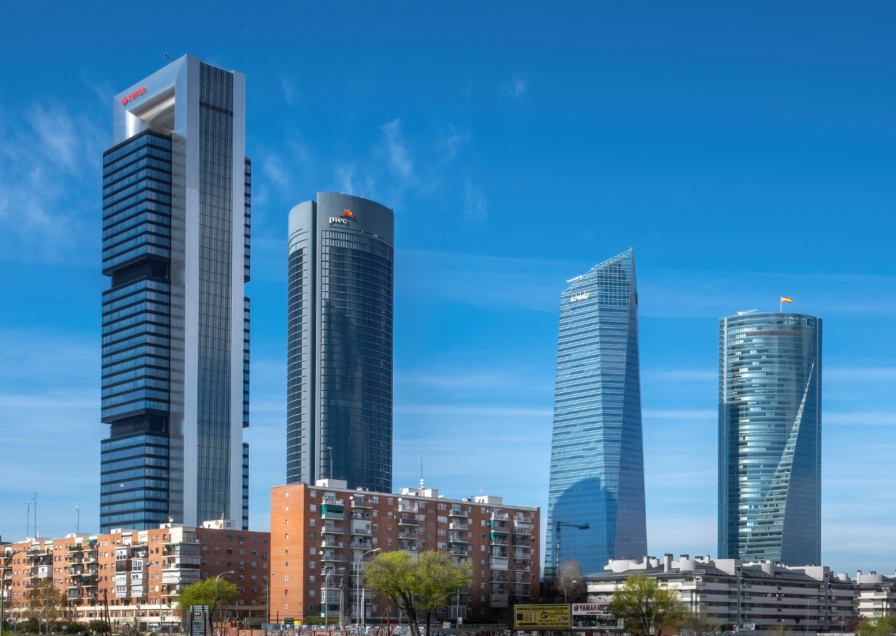
Office take-up in Madrid reached 90,000 m² during the first quarter of 2026, reflecting a solid level of activity in the current context, although showing a year-on-year adjustment of 28% compared to the high volume recorded during the same period of the previous year, according to the latest Madrid Office Market Report published by FORCADELL.
Regarding demand, Manel de Bes explains that “it continues to show a high degree of selectivity, with transactions mainly linked to relocation, consolidation, and qualitative improvement processes of spaces, rather than net expansions.”
The distribution of take-up by area reflects a balanced market performance. Decentralised areas account for approximately 30% of total take-up, followed by the outskirts, with around 24.5%, particularly standing out due to larger floor area transactions. Meanwhile, the city centre represents around 24.2% of total take-up, constrained by the limited availability of quality product, while the CBD accounts for approximately 21.3%, marked by the scarcity of available space, especially in prime assets.
In terms of the number of transactions, the market recorded a total of 73 deals during Q1 2026. The city centre led activity with approximately 32% of the total, reflecting a more fragmented and dynamic market. The CBD accounted for nearly 27.4% of transactions, while decentralised areas represented around 25%. The outskirts, meanwhile, recorded approximately 16.4% of total transactions, although with a significantly larger average floor area.
The availability rate in Madrid’s office market stands at around 8.7%, remaining at relatively contained levels overall, although with significant differences between areas, according to data from FORCADELL. The CBD shows particularly low availability, at approximately 2.6%, reflecting a structural shortage of quality product. Central areas also maintain tight levels, while decentralised areas and the outskirts concentrate most of the available space, with rates above 12%.
Availability in prime assets remains limited, due both to sustained absorption and to stock reduction resulting from repositioning processes and changes of use. In this context, the market continues to show a clear duality between high-quality product, characterised by structural scarcity, and secondary assets, which require greater commercial flexibility.
At the same time, office rents in Madrid continue to follow an upward trend, especially in higher-quality assets and prime locations, where demand pressure remains high. In the CBD, prime rents stand at around €46/m²/month, reaching peak levels in certain landmark assets, while along the Castellana axis, levels approach €40/m²/month, consolidating its position as one of the market’s main benchmarks.
In terms of average rents, the market shows a clear differentiation by area: the CBD reaches €35.96/m²/month, the city centre €27.43/m²/month, decentralised areas €15.64/m²/month, and the outskirts €12.83/m²/month. The market-wide average rent stands at approximately €24.20/m²/month.
“The office market in Madrid therefore continues to show active dynamics, increasingly conditioned by product availability and by growing segmentation based on asset quality, location, and technical specifications,” states Manel de Bes. Sustainability, energy efficiency, and space quality are consolidating as key decision-making factors, within a context marked by the consolidation of hybrid working models and a stronger focus on flexible and experiential spaces.
Newsletter